


© LAT Images for Mercedes-Benz Grand Prix Ltd
Former F1 driver Jolyon Palmer explains why the stewards’ decision to let Max Verstappen off the hook for his incident with Lewis Hamilton “didn’t make sense” to him.
In his Formula1.com column Jolyon Palmer gave his analysis of Lewis Hamilton and Max Verstappen’s Brazilian Grand Prix Lap 48, Turn 4 incident and the stewards’ decision on it.
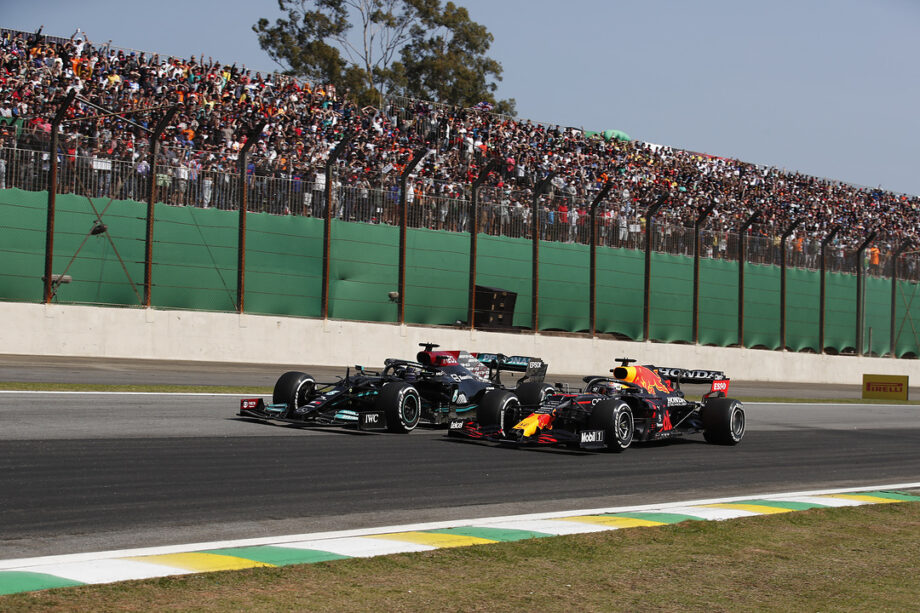
“On Lap 48 in Brazil, we had another controversial moment between our two championship challengers at the front of a Grand Prix,” Palmer wrote.
“Lewis Hamilton attacked Max Verstappen down to Turn 4. Using the DRS he managed to get almost fully ahead of Verstappen before the braking zone, but Verstappen defended robustly, with both drivers going off track in the process as the Dutchman retained the lead.
“It was a manic weekend for the stewards, who took almost 24 hours deliberating whether Hamilton should have been excluded from qualifying or not the day before.
“With the title protagonists starting at opposite ends of the grid, that could have been the end of the deliberations. Not so.
“Hamilton had made 15 places up on Saturday, and a further eight places on Sunday by the time he was fighting Verstappen for the lead, but all of those other moves were different to fighting a title rival for a race win.”
At the time the stewards decided not to investigate Verstappen’s move. Palmer gives his opinion on the decision.
If you like SilverArrows.Net, consider supporting us by buying us a coffee!
“I absolutely understand why Verstappen did what he did, but was it a legitimate defensive move? Was it just good, hard racing or was it a step too far?
“The incident was noted by the FIA, but then eventually deemed acceptable racing and no penalty was applied, to the dismay of Mercedes – as they would prove by lodging a ‘Right of Review’ request on Tuesday.
“But it did give us more of a grandstand finish than the famous Canadian Grand Prix of 2019, when a five-second penalty for Sebastian Vettel killed off the race.
“In my opinion, though, I’m dubious about the decision. For me, it raises questions about precedents for racing in the future – and from a sporting point of view, it didn’t make sense to me.
“I’m sure that this was an immensely tough decision for the stewards to make, given everything at stake with their decision here, and the weight of the outcome hanging over them as it was in Canada, Austria or Monza in 2019.
“But for me, it was a clear case of forcing another driver off track.
“We’ve had many incidents this year of drivers forcing each other off the road, and some have been contentious, like when Lando Norris was penalised for squeezing Sergio Perez onto the gravel in Austria.
“Had Verstappen managed to at least stay on the track himself then I think we would be in the grey area seen so many times already this year; is it hard defence and the driver on the outside has to back off, or is it squeezing another driver off the road?
“If Verstappen had stayed on track, I think the former could be argued, and that is what has been the case in almost all circumstances this year.
“But the fact that Verstappen was so late on the brakes, from a tight angle, meant he also had to run off the road by multiple car widths.
“That denied Hamilton the chance to stay on track. That for me is a clear case of a driver being forced off.
“If this sort of defensive manoeuvre is now acceptable, how can we expect another move to be completed around the outside, so long as there is the ever more popular asphalt run-off?”
Hamilton ultimately managed to overtake Verstappen on the track and win the race, so Palmer argues that this made the stewards’ decision less contentious in the media.
“Had Hamilton not managed to make the move stick on the road, I imagine that the stewards’ earlier decision would have become more talked about.
“It’s a tough job and it was a tough decision to make, but maybe they were breathing a sigh of relief that it became irrelevant to the outcome by the end,” Palmer concluded.


